Cultural Policy Yearbook
Cultural Policy Yearbook is an international, peer-reviewed publication, producing high-quality, original research published by Istanbul Bilgi University Cultural Policy and Management Research Centre (KPY). The Yearbook is a bilingual, and annual book published both in English and in Turkish in two separate volumes. CPY Yearbook consists of three sections including a dossier named “Focus” which consists of a title formed around the conceptualization and contemporary discussions on the chosen theme as well as "Open Space" and "Review".
The “Focus” theme is determined by the editor(s) appointed by the editorial board for each issue.
The “Open Space” gives coverage to articles on the latest developments and debates in the area of cultural policy and management which are not included in the “Focus”.
The “Review” includes short information, criticism, and commentary on publications, legislation, and international documents, events, works of art, and academic/cultural meetings.
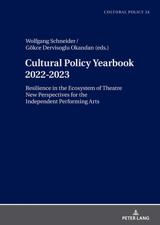
Details
Pages: 294
Publication Year: 2025
ISBN (PDF): 9783631925829
ISBN (ePUB): 9783631925836
ISBN (Hardcover): 9783631925812
DOI: 10.3726/b22277
Language: English
Keywords: Cultural PolicyTheatre ManagementPerforming ArtsThe freedom of the arts
Published: Berlin, Bruxelles, Chennai, Lausanne, New York, Oxford, 2025. 294 pp.
Product Safety: Peter Lang Group AG
Summary
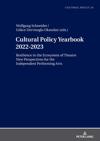
The Cultural Policy Yearbook is an international, peer-reviewed publication, producing high-quality, original research published by Istanbul Bilgi University. The 2022–2023 edition is published in English, with a Turkish version available exclusively as an e-book, supported by the University of Hildesheim. The "Focus" theme for 2022–2023 is "New Perspectives for the Independent Performing Arts".
Independent theatre is essential, vibrant, and invigorating; through its cross-border co-productions, festivals, and networks, it allows us to continually re-discover our lives through dialogue and exchange. Despite language differences, there is a high level of geographical mobility among artists. Festivals serve as important points of contact, with mobility and flexibility facilitated by numerous organizing groups, alliances, and networks recognized and supported by cultural policymakers. Articles from the West, South, and East discuss the resilience of the independent performing arts post-COVID and the challenges of a transforming world.
Table of Contents
- Focus (Editors: Wolfgang Schneider, Gökçe Dervişoğlu Okandan) Resilience in the Ecosystem of Theater: Cultural Policy Perspectives for the Independent Performing Arts (Wolfgang Schneider and Gökçe Dervişoğlu Okandan)
- 1.1. Collaborative decision-making and participation in the independent cultural scene: Transnational cultural networks in precarious working conditions (Ana Letunić and Jovana Karaulić)
- 1.2. Diversity as equal opportunities – A cultural policy framework for a heterogeneous performing arts scene (Özlem Canyürek)
- 1.3. Transforming the theatrical landscape: The paradigm shift in funding for the independent performing arts in Germany and Europe (Wolfgang Schneider)
- 1.4. Decolonization of cultural policy in times of transformation – The role of performing arts in South Africa (Khayelihle Dominique Gumede and Rolf C. Hemke)
- 1.5. Bridging the Performing Arts and Tourism to achieve regional revitalization−Cultural policy in Japan and the challenge faced by the Professional College of Arts and Tourism− (Kazuo Fujino)
- 1.6. International cooperation, mobility and the status of the artist in the independent performing arts: A plea for more fair policies and practices (Cristina Farinha, Matina Magkou and Anna Steinkamp)
- 1.7. Amongst a world crises resilience of theaters in Türkiye (Yeşim Özsoy)
- 1.8. Macro-level determinants of the number of theater audiences: The case of Turkey (Selda DUDU)
- 1.9. The value of small live music venues in the music ecosystem: Research on the alternative music scene of İstanbul, Turkey (Ceyda Atay)
-
Open Space (Editor: Serhan Ada)
- 2.1. Futures and future-being for cultural policy – Cultural policy as political imaginary of human possibility (Serhan Ada and Jonathan Vickery)
- 2.2. Reflections on resilience: South Africa’s Sustaining Theatre and Dance (Stand) Foundation as a response to the existential challenge posed to theatre and dance by the Covid-19 pandemic (Mike van Graan)
-
Review (Editor: Miyase Çelen)
- 3.1. The theater of the real in the 21st century: On the “Smuggled Tea Performance” and “Telemachos: Should I Stay or Should I Go” (Şafak Ersözlü and Banu Ayten Akın)
- 3.2. Being alive in the garden: Gümüşlük Academy Theater Festival (Zeynep Nur Ayanoğlu)
- 3.3. Book review: Cultural heritage management why and how? Experiences and discussions from Türkiye (Seda Naniç Zeybek)